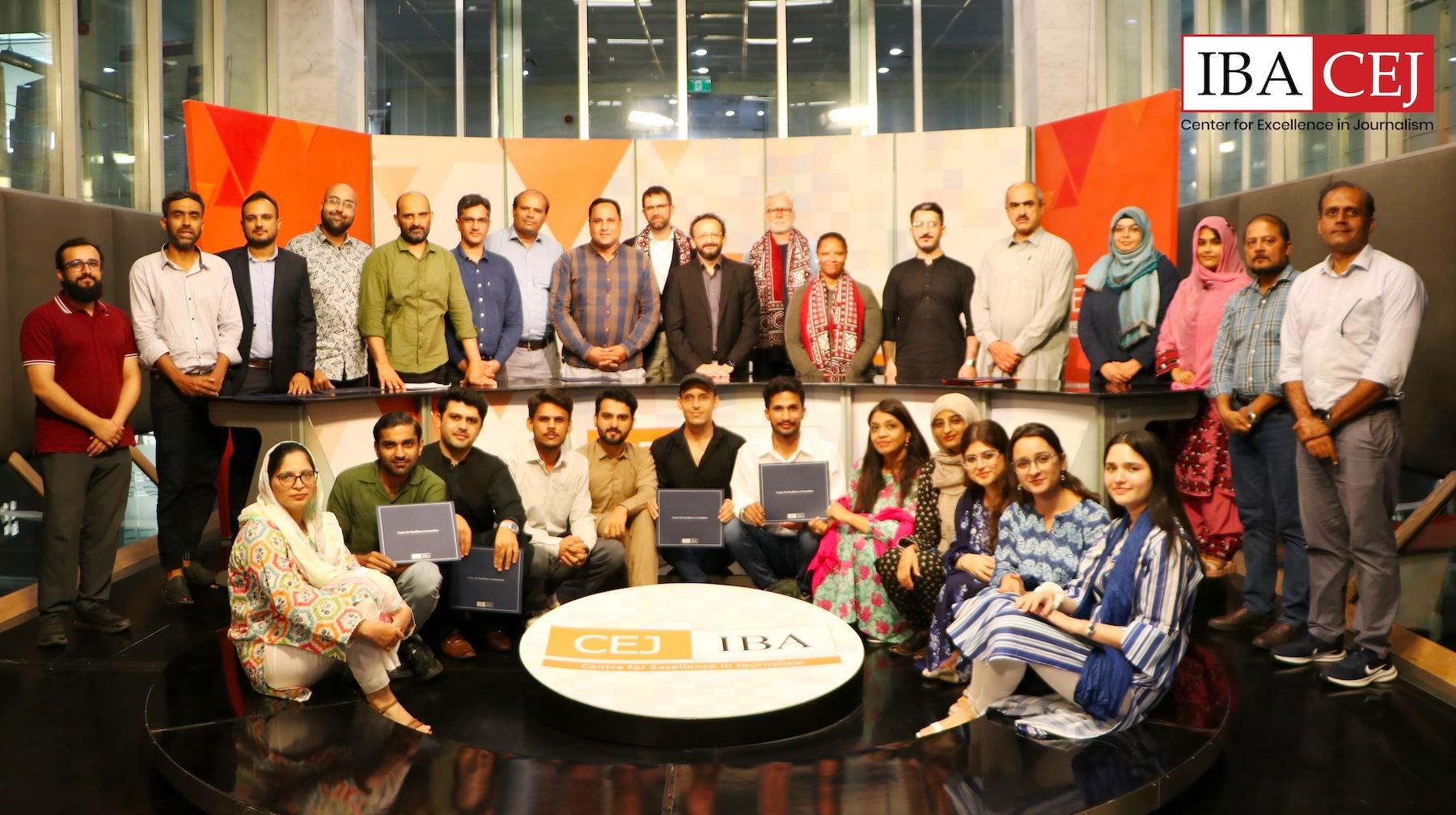
AidData’s two-year training program with media and government officials in Pakistan continued recently with an in-person data journalism training in Karachi. A recruiting call resulted in more than 230 applications from every part of the country. AidData, a research lab at William & Mary, and its lead partner, the Center for Excellence in Journalism (CEJ) at the Institute of Business Administration, one of the country’s top universities, had the difficult job of narrowing down a robust field of applicants to the eventual cohort of 25 professional journalists. Reporters, editors and producers were drawn from print, TV, radio and online outlets and platforms, as well as a select group of CEJ graduate students.
The feedback and evaluations from the summer program will help inform a new set of trainings for data journalists and government officials that AidData will conduct this January in Islamabad, held in partnership with Media Matters for Democracy (MMD), a non-profit focused on media literacy and digital democracy, and the Center for Economic Research in Pakistan (CERP), a leading research institute. Applications for both workshops are currently open.
.JPG)
Pakistan has a vibrant media environment, but a pre-survey of participants found nearly three-quarters cite a lack of access to reliable data as being a primary challenge to doing their work. This is compounded by widespread difficulties in information verification, as well as limited access to expert sources.
The country is home to the China-Pakistan Economic Corridor (CPEC), a massive ($65+ billion) infrastructure project funded by China, so AidData brought to the workshop its data and analysis of China’s development finance footprint and strategies globally and within Pakistan. CPEC has been fraught with challenges, including turmoil and unrest in Balochistan province which make it difficult to access the port of Gwadar, the terminus for CPEC. From pre- and post-workshop quizzes, student understanding of infrastructure project financing like CPEC emerged as the area of greatest improvement—a shift from limited knowledge to competency in a critical area for business reporters and producers. The China-Pakistan Economic Corridor (CPEC) knowledge area, which received the highest average self-rating before the training, increased as well post-training, suggesting that even participants with prior knowledge enhanced their understanding on this hot-button topic.
Like many developing nations, Pakistan has been whiplashed by a changing environment, with droughts, searing temperatures, and disastrous floods having affected all regions of the country over the past few years. Workshop attendees were keen to write data-driven stories that provide a voice for local communities on how these events have impacted their lives. Climate change is a highly-charged issue, touching on domestic politics, planning and administration, economics, and foreign policy, with many in Pakistan believing they are suffering through a crisis caused by Global North nations over decades and centuries.
After onboarding earlier this summer, workshop participants were admitted to the AidData and William & Mary portal for the online component of the training, which included coursework on data, data visualizations, and development finance. The week-long, in-person training took place at CEJ, co-taught by three AidData instructors, CEJ faculty and staff, and guest lecturers. The program was co-led by CEJ CEO Shahzeb Jillani, who also hosts a nightly panel show on Dawn News TV, a top news channel in Pakistan. Guest lecturers included Khurram Hussain, a well-known business journalist; Fatima Attarwala, Dawn investigative editor; Shahzeb Ahmed, a CEJ faculty member and Dawn reporter; Mutahir Khan, co-founder of Data Darbar, a finance data startup; and Miftah Ismail, former finance minister of Pakistan. Faculty and students also enjoyed a field trip to the bustling Dawn newsroom.
.jpg)
“The training was noteworthy for the level of engagement throughout,” said Sethu Nguna, AidData Training and Instructional Design Manager who co-led the training program. “In addition to the high number of applicants and strong engagement with the online content, we were thrilled that there was little attrition during the week-long in-person training, despite many of the attendees working on deadlines as busy. Attendees were prompt, enthusiastic, and stayed each day beyond the end-time and through the entire week. This is not always the case with trainings of this kind.”
Feedback from participants is also critical as AidData develops and expands its Training Initiative—including a new online course on navigating global development finance, delivered in partnership with William & Mary's Studio for Teaching & Learning Innovation. The Pakistan suite of trainings builds on a data journalism course in the Philippines that AidData taught last December with Rappler, a Nobel Peace Prize-winning Philippines media outlet.
Karachi attendees suggested they would benefit from more hands-on practice and additional technical training through follow-up sessions. One participant evaluation noted it would have been good to have “more time to complete the modules, because I was completely unaware of the concepts before this training.”
Many participants also indicated interest in a peer learning network to facilitate experience sharing, troubleshooting, and collaboration among fellow trainees. Overall, the feedback was notably positive. “It was truly a lifetime experience learning from AidData's trainers at Center for Excellence in Journalism-IBA Karachi. In a world of constant technological change, data journalism serves as the ultimate watchdog, scrutinizing the facts buried in the figures,” said one evaluation, while another highlighted that the workshop was “incredibly insightful, teaching us how to source and utilize relevant data for compelling data journalism stories. I'm excited to apply these newly acquired skills and perspectives in my work.”
.jpg)
Quizzes and evaluations conducted by AidData at various stages during the training will be used to inform and refine the design and curricula for future trainings in Pakistan. The program is supported with funding from the U.S. Department of State and the U.S. Consulate General in Karachi.
Next up: AidData instructors will be in Islamabad in January to train a new set of data journalists and to work with Pakistan government officials on AidData’s forthcoming online tool for credit analysis. The latter training is designed to help finance and debt officials analyze and negotiate the terms of sovereign credit proposals. The tool allows users to evaluate the financial implications of both current and prospective loans (including renewals or re-negotiations), using standardized metrics and objective benchmarks. This will help borrowing countries—particularly those negotiating with major creditors like China—secure more favorable lending terms. AidData previously conducted pilot testing of the tool in Pakistan, and it is now being expanded to help debt officials in developing countries worldwide to make well-informed decisions and secure better credit deals for their countries. Next year, AidData will also launch a new Training Hub that will provide an open learning space with courses, tutorials, and interviews for learners seeking to improve their data skills and discover more about AidData’s work.