

The U.S. and China are engaged in long-term strategic competition across nearly every domain of power—yet preparing executive leaders for effective decision making in these arenas is extraordinarily difficult. Classroom instruction alone cannot replicate the pressure, ambiguity, and second-order consequences of real strategic decisions on trade policy, supply chains, alliances, and the use of military force. Wargames and simulations can, but only when designed rigorously and executed at a professional level.
To address that gap, the Statecraft Simulations Group (SSG) was established. Part of the Robert M. Gates Initiative in American Statecraft at William & Mary, the SSG delivered its inaugural simulation, Fractured Order, at the W&M Washington Center earlier this year. In collaboration with our team, I am now developing Plenum, an online platform for future simulations, built around an architecture that enables deep, data-driven analysis of leaders’ decision-making patterns during gameplay. This post introduces the project, the partnerships and people that built it, and what our experiences are now generating.
How we’re solving the problem

Sponsored by the Gates Global Policy Center and the Global Research Institute, the SSG’s mission is to design and execute seminar-style simulations that place senior government, NGO, and business leaders inside realistic strategic competition scenarios—not as observers, but as decision-makers who must live with the consequences of their choices. Related to AidData’s broader training program, myself and other researchers at AidData are collaborating with SSG to help design the simulations and provide research that informs them.
The Fractured Order team grounded the simulation in two baseline conditions: the current U.S. domestic political environment and the state of the U.S. economy. From that foundation, we mapped five areas where China has been systematically building competitive advantage—economic levers, critical manufacturing, critical technologies, supply chains, and minerals. Together, these defined the landscape participants had to navigate as they worked through the central challenge: how to sustain and strengthen U.S. alliances under real pressure. Because the decisions had to reflect reality rather than conjecture, research produced by AidData was crucial to the foundation on which the entire exercise depended.
The research that grounded the scenario
Among the key data sources our team drew on was an AidData policy report, Power Playbook: Beijing's Bid to Secure Overseas Transition Minerals. The report analyzes an accompanying dataset that systematically tracks China’s official sector financial commitments for copper, cobalt, nickel, lithium, and rare earth element extraction and processing operations across Belt and Road Initiative participant countries over a twenty-two-year period. Its central finding? Beijing has methodically expanded control over global critical mineral supply chains through financing arrangements that are deliberately opaque. This framework gave the design team an empirically grounded picture of the current asymmetric competitive landscape.
Our grounding in empirical evidence separates our simulation from an elaborate thought experiment. When Fractured Order participants faced decisions about mineral access and supply chain vulnerabilities, they didn’t just guess: they had to make decisions anchored in insights that AidData’s research team had spent years assembling.
Testing before the table
Before Fractured Order reached its intended audience, it went through multiple rounds of structured testing. The test subjects, William & Mary faculty and researchers, brought an analytical rigor and subject matter depth mirroring a senior executive cohort. They were well-suited to stress-test the scenario logic, probe the role mechanics, and identify where information flows between teams created confusion. That testing directly shaped the simulation that participants experienced.
The event
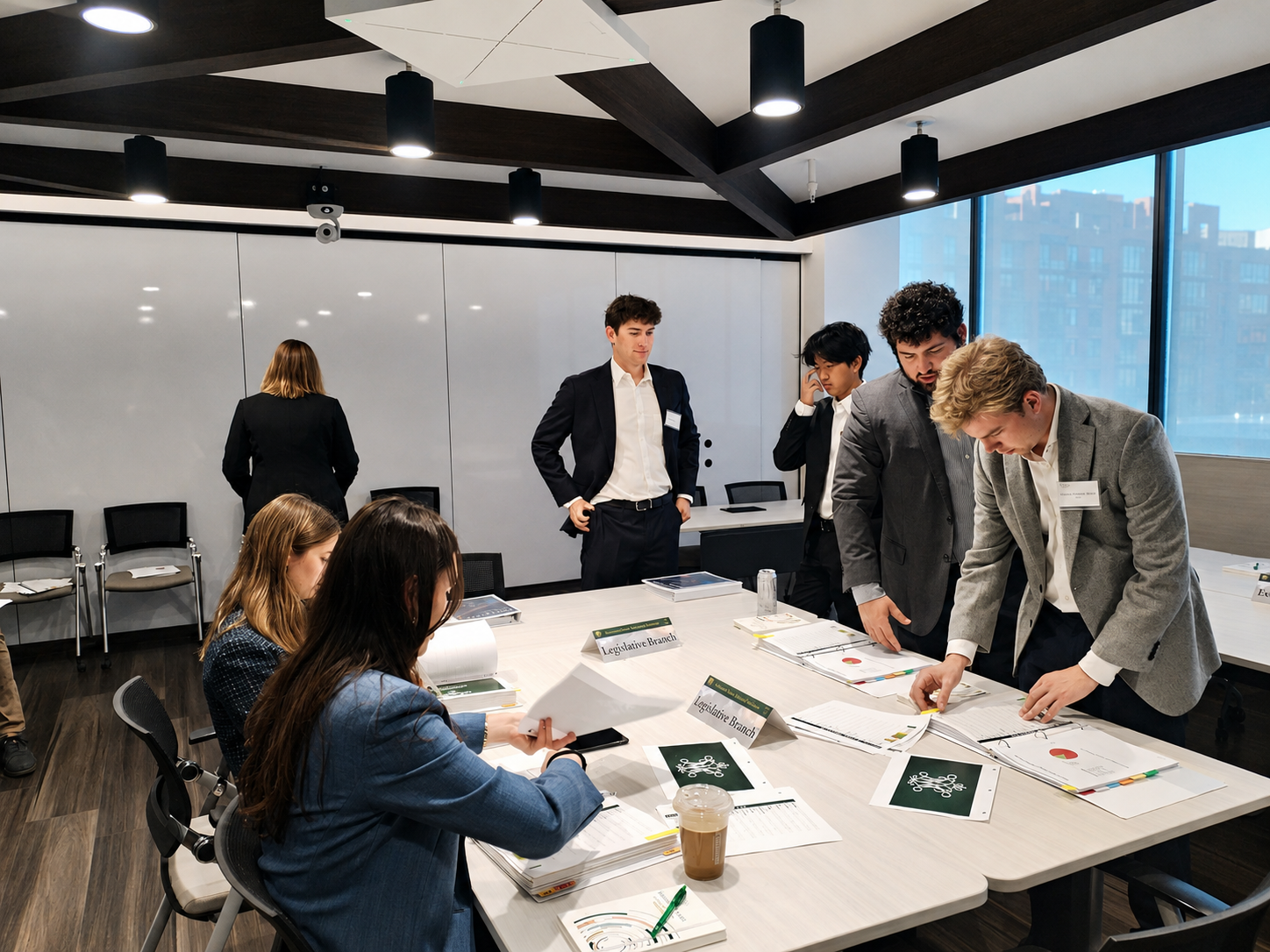
Fractured Order was delivered at the W&M Washington Center in Washington, D.C. near the heart of the policy community it was designed to serve. W&M undergraduate students from Government and International Relations Departments filled key simulation roles alongside senior leaders, giving both current experts and the next generation of national security practitioners direct exposure to the pressures of executive strategic decision-making.
The event demonstrated that our model works. A university-based team, with the right research, the right design methodology, and the right partners can deliver a simulation that meets the standard of professional-grade executive education.
What comes next?
The delivery of Fractured Order confirmed what the team had anticipated: running simulations at this level of fidelity requires purpose-built infrastructure. Alongside our partners, I am now leading the conceptualization, design, and development of a dedicated platform for the SSG, built around the role architecture of professional simulation experiences. User testing for the platform is currently ongoing.
As we look to improve, the post-event analysis is already underway. We’re systematically examining the decisions participants made, the trade-offs they navigated, and the strategic reasoning they surfaced under pressure—producing the kind of policy-relevant analytical output that sponsors can act on and that advances the SSG’s broader research agenda.
The Statecraft Simulations Group is a research and experiential education initiative of William & Mary's Government Department. The SSG's inaugural simulation was made possible through the leadership of General Charles Lyon (USAF, Ret.), Adjunct Professor in the William & Mary Government Department and non-resident Senior Fellow at the Mitchell Institute for Aerospace Studies and former Director of Operations at Air Combat Command, Chief of the Studies, Analysis, and Gaming Division (J-8) on the Joint Staff; the research and design leadership of Samantha Hughes, Assistant Director for the St Andrews Joint Degree Programme at William & Mary; the research contributions of AidData at William & Mary; the instructional design contributions of Matthew Newcomb and the W&M Whole of Government Center of Excellence; and William & Mary students from the Government and International Relations programs. Plenum, the SSG's simulation platform, is under development in partnership with Sethu Nguna of AidData.
