
National Security
Insights for tomorrow's global challenges amid a changing international order





Overview
Amid a changing international order, AidData generates myth-busting evidence to inform national security policy. We conduct data collection operations where there are major evidentiary blind spots, using cutting-edge geospatial and satellite imagery analysis, surveys and snap polls of leaders in 149 countries, and other open-source methods.
For more than a decade, AidData has also served as an early warning system for shifts in Beijing's geoeconomic and geostrategic priorities. We've done so by monitoring China's vast overseas portfolio of loans and grants, including investments in high-income countries and sensitive sectors; maritime infrastructure; and critical mineral supply chains.
Our national security research activities are increasingly focused on the strategic risks and opportunities related to international migration; military and security assistance; sanctions and tools of economic statecraft; U.S. investments and partnerships in the Indo-Pacific; and the soft power influence of the U.S., China and Russia.
Priority Areas
China's global lending and grant-giving portfolio—including in high-income countries
Our data on cross-border aid and credit from Chinese entities is a go-to source for governments, international organizations, and the media
Our team of more than 140 fact-finders and financial analysts meticulously maps China's overseas loans and grants, following the flow of money in to sensitive sectors—such as microprocessing technology, robotics, defense production, quantum computing, and biotechnology—and identifying potential points of strategic leverage. We're also launching a new effort to track the full range of China's military lending and grant-giving operations around the globe.
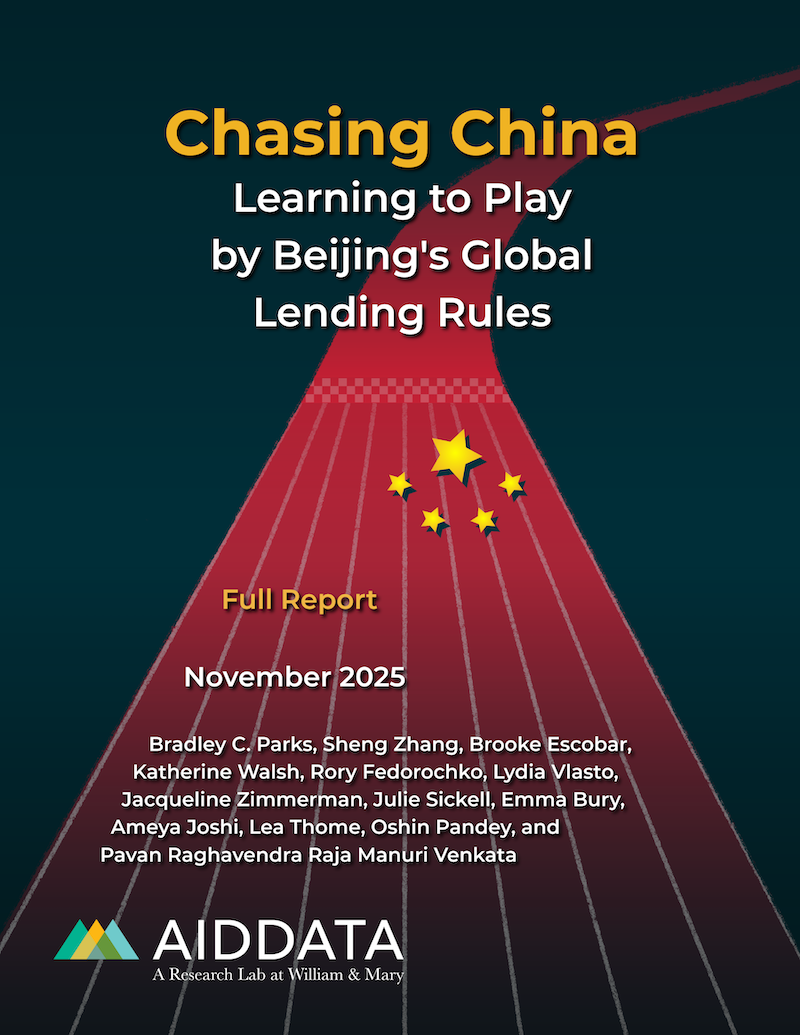
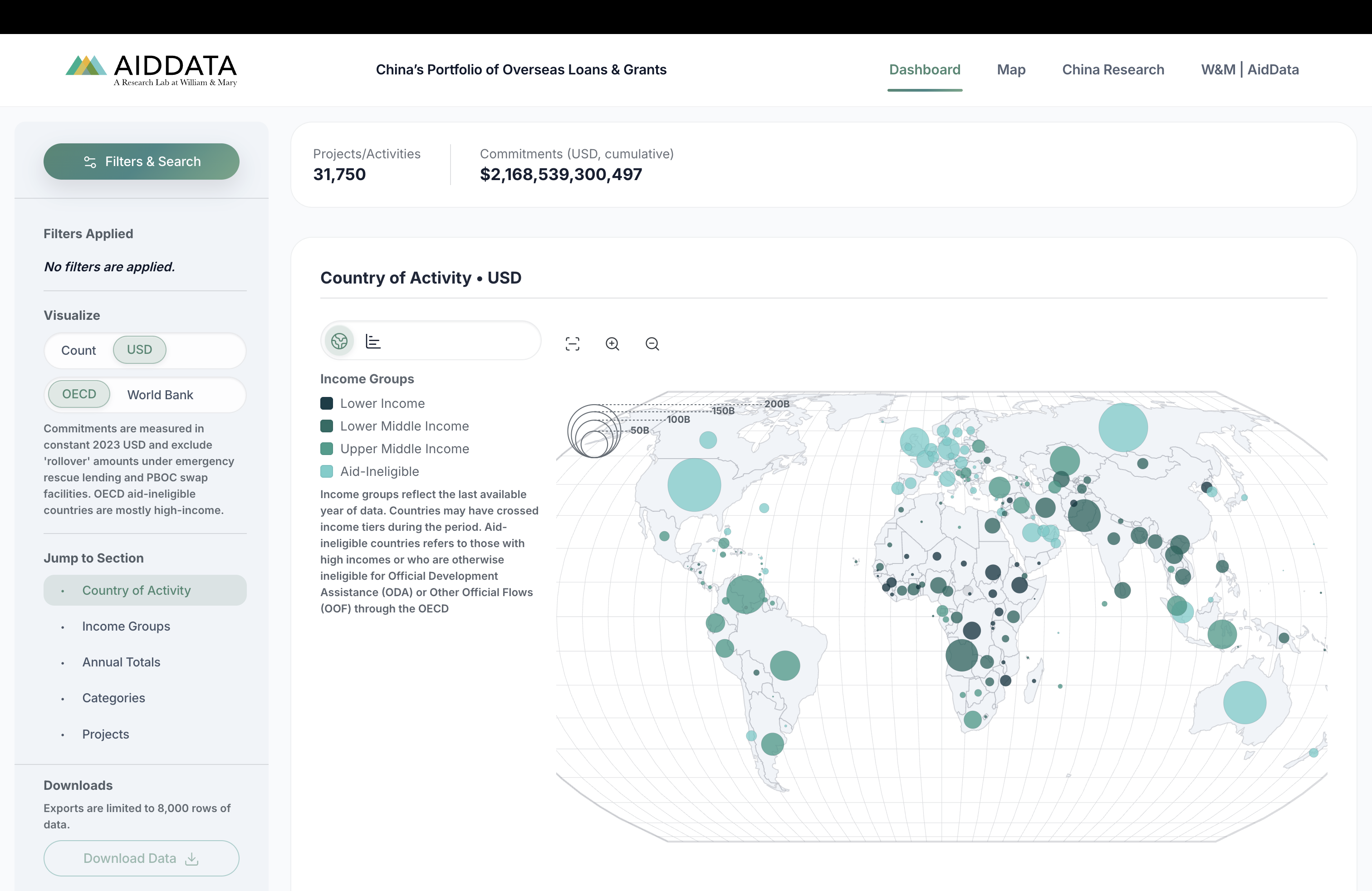
Beijing's massive lending and grant-giving portfolio remains shrouded in secrecy, with questions about its true scale, purpose, and impact. Our recent Chasing China report provides a uniquely comprehensive and granular source of evidence: a dataset tracking 33,580 projects from 1,193 Chinese state-owned entities worth $2.2 trillion across 217 countries from 2000 to 2023. It traces the circuitous routing of funds through offshore shell companies and international bank syndicates, while revealing the ways in which Beijing uses the power of the purse to take possession of critical technology assets—such as the semiconductors used in fighter jets, submarines, precision-guided munitions, radar systems, and 6G telecom networks.
China.AidData.org ↗
Seach $2.2 trillion in loans and grants from China
China's sovereign debt restructuring and loan performance
Providing the first comprehensive analysis on the secured lending practices of Chinese creditors
We maintain a searchable online repository of unredacted contracts between 20 Chinese creditors and 155 borrowers from 60 developed and developing countries. AidData is able to make this large and rapidly expanding trove of transactional documentation accessible to the public through our Tracking Underreported Financial Flows (TUFF) methodology.
Our analysis of the terms and conditions in these contracts has helped governments and multilateral institutions understand how China is seeking to gain a competitive advantage over its rivals. Recent publications include How China Lends, How China Lends 2.0, How China Collateralizes, Bargaining with Beijing, and Is Beijing a Predatory Lender?

China's overseas investments in critical minerals
We're studying China's playbook and the implications for the U.S., its allies, and third-party countries
Our Power Playbook report helps policymakers understand how China is using financial instruments to bankroll critical mineral operations in developing countries. The building blocks of modern technology, these minerals are key for advancemed manufacturing, AI, defense, and renewable energy technologies.
We separate fact from fiction to document how Beijing is leveraging a massive stockpile of foreign exchange reserves to expand its control over key segments of the global supply chain for critical minerals. We've also published in-depth mining site profiles to help policymakers gain greater insight into how these extraction and processing operations play out on the ground.
We’re now expanding the scope of our investigation to track China's use of a broader array of financial instruments (including equity investments and private sector commitments) for investments in developed and high-income countries for all 32 critical minerals listed by the International Energy Agency.

Maritime connectivity and control
We're tracing the impact of China's investments in ports, shipbuilding, containers, scanners, and related infrastructure
Based in the Hampton Roads region of Virginia, home to the world’s largest naval base and the largest U.S. shipyard, AidData leans into its maritime connections through innovative work that includes data-driven reports and mapping to comprehensively identify China’s global portfolio of state-directed investments in overseas ports and harbors and the potential for dual use. The depth and breadth of our data is unmatched.
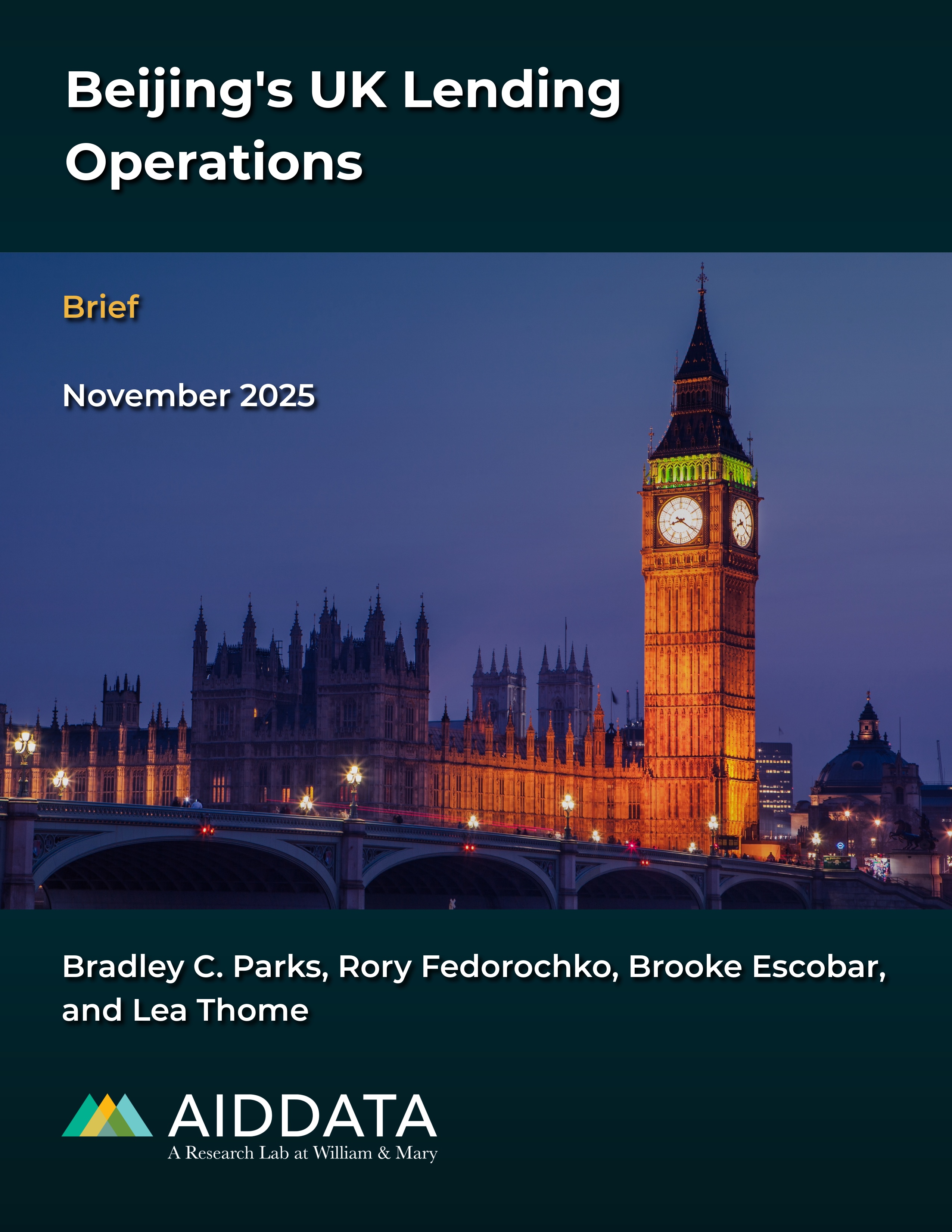
We're studying U.S. and rival nation shipbuilding efforts; the security implications of China's stakes in shoreside infrastructure like cranes and customs scanners; and the key sea lanes for critical commodities and resources that might serve a military purpose or establish commercial dominance. Our latest reports include Anchoring Global Ambitions, Harboring Global Ambitions, and China’s Global Scanner Dissemination.
Migration and security
We're creating a one-stop-shop to advance migration scholarship to inform policymaking
The number of people forced from their homes by conflict and disaster is at an all-time high. Driven by economic push-and-pull factors, this unprecedented global migration presents unique security challenges. But as global migration climbs, policy-relevant research on migration's causes and consequences has struggled to keep up.
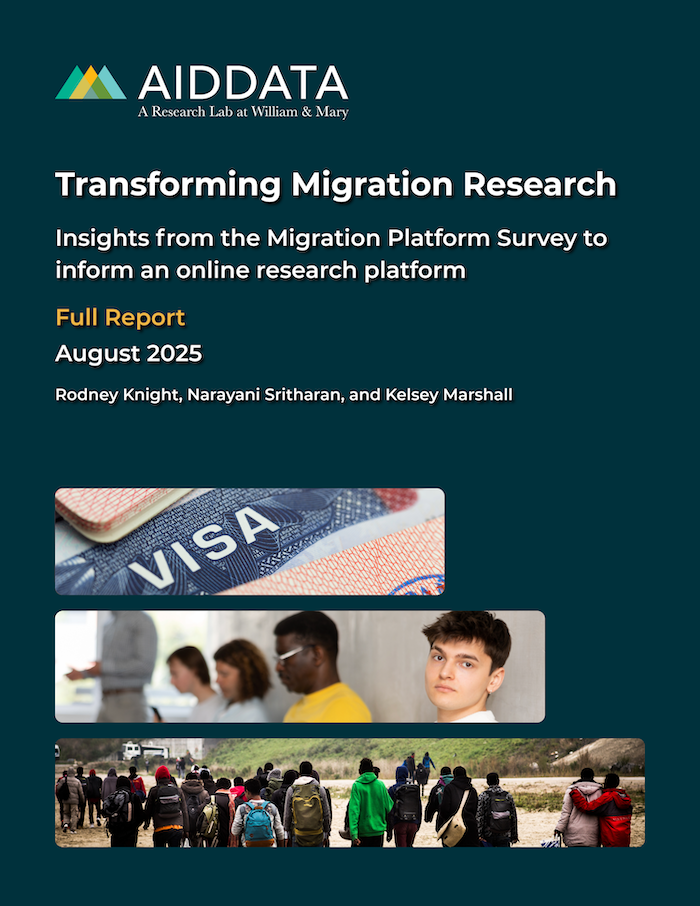
AidData, in collaboration with Aptima and with funding from the U.S. Department of Defense, is filling the gap with an online migration research platform that leverages advanced AI. Designed to centralize resources and facilitate collaboration, the platform's development is being informed by a survey of nearly 2,000 migration researchers worldwide.

U.S. policy priorities from reputational security to economic statecraft
We're helping inform bipartisan decision-making on U.S. security issues
Our research helps informs U.S. strategy and foreign policy by showing how the U.S. can restructure its global development investments, strategic communications efforts, and sanctions and economic statecraft to compete more strategically in the global arena.
In partnership with the Gates Global Policy Center, we've provided analysis for three annual forums convening U.S. policymakers and national security officials across the partisan divide for closed-door discussions.
We've also studied how governments in backsliding democracies are emulating Chinese and Russian digital censorship tactics. And we've worked to monitor the influence operations of Russia and China in critical regions—quantifying the Kremlin's influence in 17 post-Soviet countries in Europe and Eurasia and analyzing Beijing's public diplomacy and media influence in Asia.

Featured Reports





Research Team
For technical or research inquires, contact:






For partnership and media inquiries, contact:

Alex Wooley
Director of Partnerships and Communications
Our Partners


