
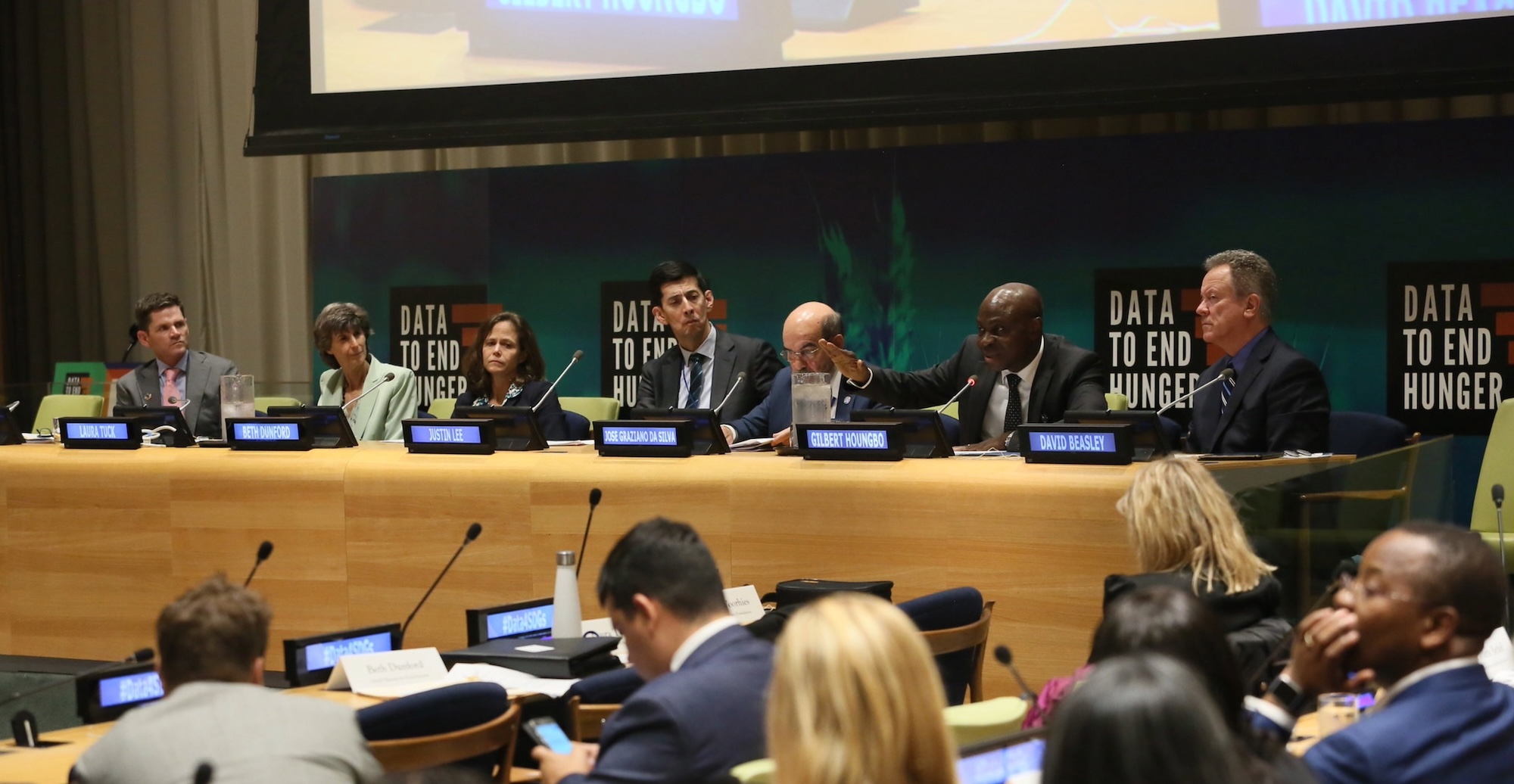
For more than a decade, AidData has been asking hard questions about development data: What data do we actually need? Who uses it? Who pays for it? And what happens when the systems we rely on begin to falter? These questions have always mattered, but today they carry renewed urgency as international development data systems face major funding cuts. As a consequence of the budget cuts, AI is increasingly being used to fill gaps in the data. But AI is not a magic fix—it can only work with the data it is given and the risks of poor-quality or incomplete data run high. Flawed input can retrench inequities, distort resource allocation, and undermine trust in both the data and the systems built on it.
This moment demands clarity. As international aid budgets contract and the world reassesses whether—and how—we will realize the goals set out in Agenda 2030, aid agencies, private philanthropies, and partner governments need reliable, actionable data to target scarce resources. But the path to “better data" is not simply producing more of it. In 2017, we were raising a simple but uncomfortable point: development data is only as valuable as the decisions it informs. We argued that “we should not measure what we do not use,” a reminder that every dollar spent on data is a dollar not spent on life-saving medicine, disaster relief, or essential public services. However, this argument presumes that the right data is being used in the first place. With smaller aid budgets, it’s even more imperative that investments in both development and data are impactful.
Stay tuned: AidData will publish an inventory of the most used and influential development data assets, to inform the conversation about sustainable and resilient data systems.
The Reimagining Development Data (RD²) project, a new AidData initiative supported by the Hewlett Foundation, gives us a rare opportunity to do just that. Over the next two years, we’re collaborating with data producers, users, and funders to rethink how development data systems are funded, built, maintained, and used.
What we’ve learned: A persistent gap in data production and use
Over the years, AidData’s research has consistently revealed a severe disconnect between data production and data use. Governments, donors, and NGOs invest millions of dollars each year to fill data gaps, yet practitioners have lacked the tools, capacity, or incentives to put that data to work.
The 2017 wave of AidData’s Listening to Leaders survey of Global South leaders underscored this point. Leaders told us that the most valuable data reflects local contexts and directly informs the decisions they must make. Generic, standardized global indicators, while useful for benchmarking, can at times fail the needs of those on the frontlines of policymaking and service delivery.
This insight sets the stage for two interconnected challenges we’re confronting through the RD² project.
Challenge #1. Systemic: Data governance and ownership
Calls for national data ownership are growing louder, with countries seeking greater control over the data produced within their borders, how it’s shared, who accesses it, and how it’s used. With major cuts to global data and evaluation systems, there is little alternative and this shift is not only understandable but, in many cases, necessary.
However, while the principle is clear, the practical implications are not.
At its core, this raises a fundamental tension: how can greater national control over data be reconciled with the need for cross-border coordination? Development challenges rarely respect national boundaries: pandemics, migration, and financial flows all demand cross-border collaboration. If countries restrict access to key data, how will regional and global actors respond? How will interoperability be maintained? What happens to global public data goods?
There is also little systematic assessment of what national data ownership will cost, what capacities it requires, or what the stakes are for international data access.
These are not abstract concerns—they go to the heart of how development cooperation will function in a more fragmented data landscape. And they remain largely unanswered.
Challenge #2. Relational: Data and trust
Much of the global conversation about development data focuses on capacity and infrastructure. These are real challenges, but they are arguably also solvable. With the right funding, long-term planning, and cooperation across countries and regions, countries can continue to modernize statistical systems, upgrade digital infrastructure, and train the next generation of data professionals.
But trust is far harder to build.
Trust in data—its local relevance, accuracy, independence, and political neutrality—is fragile. Citizens distrust government-produced statistics. Governments distrust donor-funded data. Donors distrust administrative data systems.
And when trust erodes, even the highest-quality data is reduced to a digital paperweight. Strengthening trust requires long-term transparency, accountability, and dialogue, confronting the political economy of data head-on.
Understanding these trust dynamics and how trust informs the use of and funding for development data systems will be an underlying component of the RD² consultations.
Looking ahead: Reimagining development data systems that deliver impact
AidData’s past work has shown that improving development data is not about producing more of it, but about producing better data. With fewer resources available, this pivot is no longer optional. The question is how to produce enough of the right data, leveraging AI and technology appropriately, while ensuring that it is trusted, used and worth the cost of generating it.
Through RD², AidData will triangulate evidence from data asset mapping, stakeholder consultations, and surveys of leaders to produce actionable recommendations for more resilient and relevant development data systems. To imagine and build a future where development data systems are more efficient, more trusted, and more impactful, we must first understand the blueprint of the systems we already have: what works, what doesn’t, and what must change. We aim to help the development community prepare for two possible futures: one in which development data receives renewed investment, and one in which it does not. Either way, the systems must adapt.
The decisions made today will shape the data landscape for years to come. RD² offers a chance to not only understand the systems we have, but to reimagine the systems we need: ones that can withstand fiscal shocks, earn trust and ultimately deliver the insights required to improve lives.
