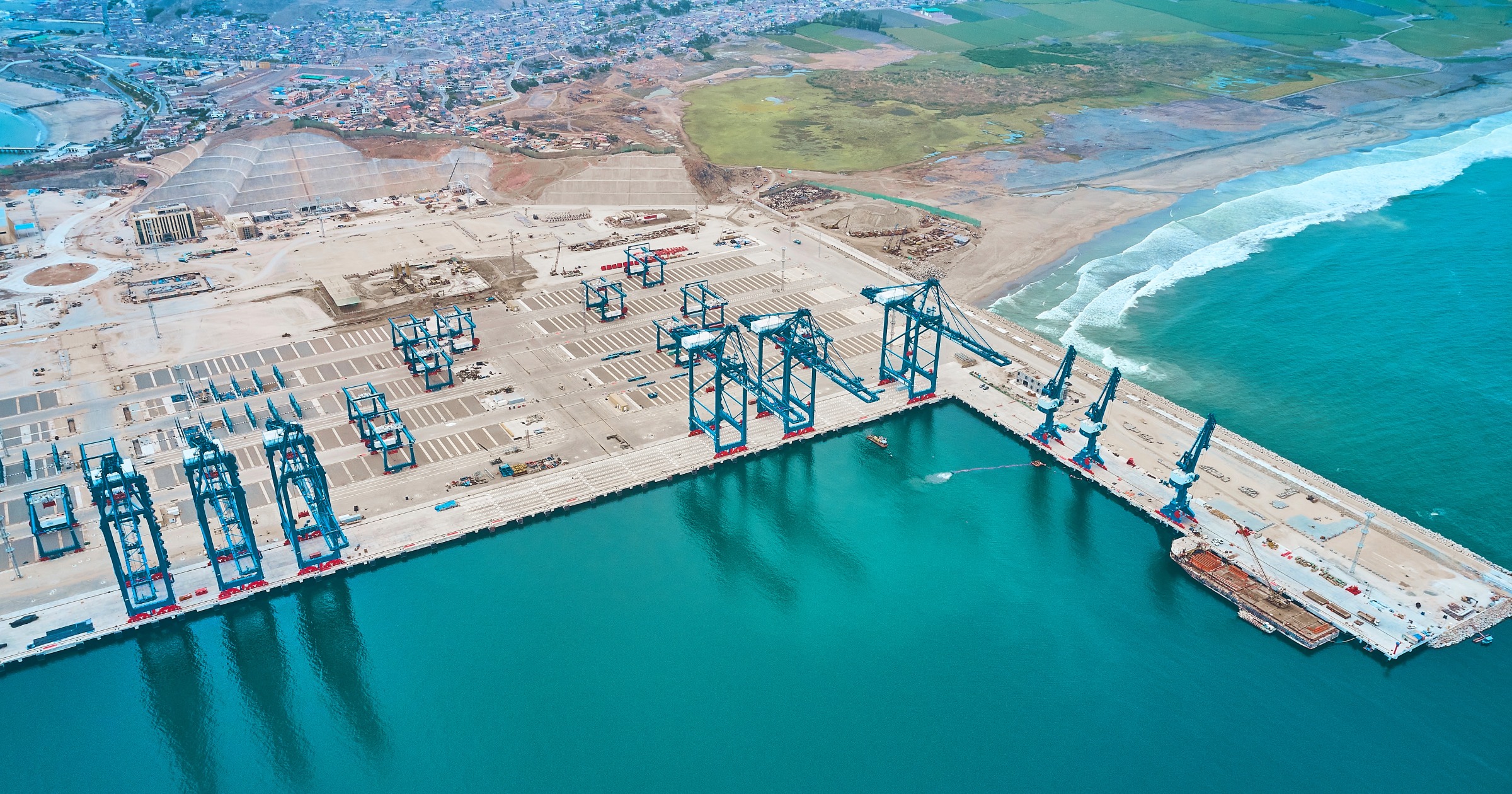
Competition between China and the United States over two ports in Panama is just one recent example of how strategically-located harbors are becoming flashpoints in great power competition. A new report and dataset released today by AidData, a research lab at William & Mary, speak to this timely issue by capturing in unprecedented detail an important plank in China’s economic and foreign policy platform: control of overseas ports.
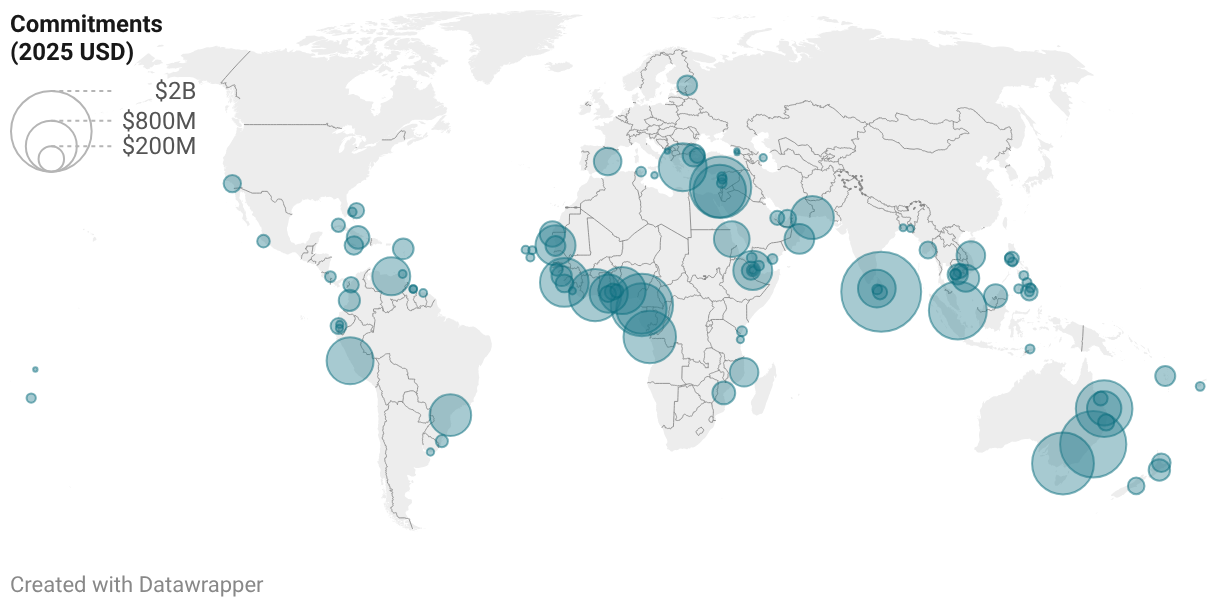
The Anchoring Global Ambitions report finds that, between 2000 and 2025, Chinese official entities and state-owned enterprises provided loans and grants worth nearly $24 billion for 168 ports across 90 countries—reaching nearly every corner of the world. The dataset, Chinese-Financed Ports Overseas and Related Terminals Dataset, Version 2.0 (CPORTS 2.0), is available online for free.
With coverage through the end of 2025, the research presents a near-real-time picture of Beijing’s global ports footprint, including new ports and those that are proposed but not yet funded, including Lobito Port in Angola, Sandino Port in Nicaragua, and Mubarak Al-Kabeer Port in Kuwait. It also includes new data on Chinese-funded shoreside port equipment, like cranes and scanners. The study provides a set of policy recommendations for China’s rivals and competitors, as well as countries that host Chinese-financed ports.
China’s shifting maritime strategy
“AidData’s research has rarely found evidence to support the ‘debt trap’ narrative popular in many capital cities. If anything, this new report strengthens the argument that China does not seek sovereign control of overseas territory as much as it does strategic security,” said Alexander Wooley, the report’s lead author and AidData’s Director of Partnerships and Communications. “China’s global maritime supply chains, anchored by its overseas port network, provide a major geopolitical benefit: a parallel logistic network that offers Beijing strategic independence, free from interference from rivals, and permits it to contemplate a military counter to containment strategies or constricting blockades attempted by an enemy in any future conflict,” said Wooley.
The report examines the role of overseas ports as key gateways to China’s supply lines. “Over the past two decades, Chinese agencies and companies have increasingly shifted towards financing seaports to retain access and export critical commodities,” said Lea Thome, a co-author of the report and a Program Manager at AidData. “These hubs of connectivity include the construction, expansion, or financing of ports in proximity or connected to other strategic investments. One recent example of this “port-railway-mine” model is Beijing’s provision of financing for the Port of Chancay in Peru in combination with its financing of mineral operations in Las Bambas and Toromocho, plus financing for ports in Brazil,” said Thome.
The data shows that Chinese state-owned creditors increasingly co-locate ports financing with other investments vital for China’s national security, such as critical mineral operations. For example, the report identifies 22 Chinese-financed mines within a 500-kilometer radius of Chinese-financed seaports and focuses on two key case studies: the Port of Chancay in Peru and the Port of Morébaya in Guinea.
Where has China directed overseas financing for ports and equipment?
In total, Chinese state-owned creditors and donors have bankrolled over 363 unique seaport projects and activities around the globe, with the most heavily-financed ports being Hambantota International Port in Sri Lanka ($1.97 billion), the Port of Newcastle in Australia ($1.32 billion), the Autonomous Port of Kribi in Cameroon ($1.17 billion), the Port of Melbourne in Australia ($1.14 billion), and Haifa Port in Israel ($1.13) billion.
“A fifth of all Chinese seaports projects were at ports with both a Chinese owner and operator, suggesting that Beijing’s priorities may extend beyond equity ownership toward securing operational control,” said Sheng Zhang, a co-author of the report and a Senior Research Analyst at AidData. “China is investing in a global network of ports that can receive its vast exports and facilitate the import of essential minerals and commodities, such as soybeans, critical minerals, liquid natural gas, oil, and more.”
For the first time, AidData researchers tracked Beijing’s overseas ports financing in high-income countries, as well as the world’s developing economies. “Chinese financing for global seaports is almost evenly split between high-income and low- and middle-income countries,” said Rory Fedorochko, a co-author and Program Manager at AidData. “Some $10.8 billion supports 29 port locations across 20 high-income countries—including Greece, Spain, Australia, New Zealand, Singapore, and Brunei—and for projects where the intent is generally commercial, rather than geopolitical.”
But the new report also suggests that the higher the level of Chinese involvement at a given port, the more likely it is to host some type of Chinese naval activity (including port calls or dockings, medical ship visits, and joint military exercises). Chinese naval activity has taken place in more than 50% of Chinese-financed port facilities where there is also a Chinese owner. There is substantially less Chinese naval activity in Chinese-financed port facilities that are not owned or operated by Chinese entities.
Implications for maritime and economic statecraft
A team of research scientists, analysts, program managers and communications professionals from across AidData conducted the analysis. The authors urge policymakers wishing to compete with China to develop a long-term overseas port financing strategy that incentivizes holistic planning and integration with other critical aspects of the maritime domain, including operations, supply lines, shipping and shipbuilding. The report also proposes concrete steps for host governments and beneficiaries to develop domestic policy assessment tools for incoming offers of port investments and port management, from China and other creditors. Lastly, the AidData researchers propose the establishment of an inter-disciplinary research task force to further the data collection and analysis effort and bring together stakeholders from government, academia, and industry.
In addition to extending aid and credit for the construction, expansion, and modernization of seaport facilities, Chinese state-owned financiers often support the provision of port equipment, such as security scanners or massive ship-to-shore cranes provided by Chinese companies like Nuctech or ZPMC. The report identifies $4.7 billion in financial commitments for 102 equipment projects at 70 seaports worldwide—from the United Arab Emirates and Australia to Peru and the Philippines.
“China’s nearly ubiquitous presence in the world’s top ports means that the U.S. cannot currently insulate itself from Chinese supply chains, in either peacetime or conflict. It must be selective about where it chooses to compete and on what dimensions,” said Sarina Patterson, a co-author of the report and AidData Communications Manager.
China's presence in ports around the world has made a clear impact on the physical landscape as well. The report leverages satellite imagery to visualize the dramatic land reclamation and development of key ports like Chancay and Tema. "Historical satellite imagery allows us to explore the construction of these ports over time in incredible detail," said Dr. Seth Goodman, a co-author of the report and a Research Scientist at AidData. The growing availability and coverage of high-resolution satellite imagery also means that activity around ports can be tracked in close to real time. The report also highlights a number of port calls made by the PLAN's Silk Road Ark hospital ship on its current deployment through the South Pacific and Central and South America. “The ability to task a satellite to precise locations means a team in Williamsburg, VA can actively monitor port developments around the world,” noted Goodman.
This new report and dataset build upon a previous investigation by AidData researchers into Beijing’s ports financing in low- and middle-income countries. Released in 2023, the Harboring Global Ambitions report has been cited by numerous government and think tank reports and in more than 60 media stories worldwide. This summer, an updated version will form a chapter in a peer-reviewed book published by Harvard University Press: Traversing the Belt and Road: The World According to China and China According to the World.
For media inquiries: Contact Alexander Wooley, Director of Partnerships and Communications, awooley@aiddata.wm.edu, +1.757.585.9875.
About the methodology
Over a three-year period, AidData researchers used a combination of automated and manual screening techniques to assemble the Chinese-Financed Ports Overseas and Related Terminals Dataset, Version 2.0 (CPORTS 2.0).
First, a systematic review was conducted of records in AidData’s China’s Global Loans and Grants Dataset, Version 1.0 (CLG-Global 1.0), which captures 33,580 projects and activities across 217 countries supported by grants and loans from more than 1,100 official sector institutions in China worth nearly $2.2 trillion from 2000 to 2023. A string detection technique was employed to identify a subset of port and port equipment finance records for potential inclusion, with a manual review of each “candidate” record to eliminate false positives. The research team then conducted additional analysis of each port record, and coders assigned values to a number of bespoke variables, including the precise name of the port, the type of port, the activity being financed, and the presence of Chinese owners or operators. Supplemental data was collected on grant and loan commitments for port projects in 2024 and 2025. (This data collection effort was supplemented by satellite imagery for targeted geospatial analysis and deep dives into specific case studies to inform the Anchoring Global Ambitions report).
The resulting CPORTS 2.0 dataset captures 363 unique Chinese-financed projects worth $23.9 billion at 168 unique ports across 90 countries from 2000 to 2025.
The dataset contains 129 variables for each project record, providing granular information on precise project locations; financial commitment amounts and currencies of denomination; financing, co-financing, implementing, and receiving agencies; project status determinations; countries of activity (where the financed projects or activities take place); countries of incorporation (where the direct receiving agencies of the financial or in-kind transfers are legally incorporated); planned and actual commitment, implementation, and completion dates; borrowing terms (including information on the maturities, interest rates, grace periods, grant elements, and sources of collateral); and detailed narrative descriptions.
Additionally, the CPORTS 2.0 dataset contains 29 unique variables not found in the AidData CLG-Global 1.0 dataset—including information on the specific type and purpose of financing for ports and equipment; prior Chinese naval activity at ports (including port calls, hospital ship visits, and joint exercises); and the presence of Chinese state-financed mines near ports.