
.jpg)
The foreign development assistance landscape has changed dramatically over the past year. In response to highly visible cuts to government aid programs, public and private foundations alike have quietly shifted their efforts across sub-Saharan Africa, aiming to keep essential operations running and save suddenly imperiled lives.
In the immediacy of this upheaval, longer-term development priorities—like promoting global gender equity and measuring the effectiveness of programming—took a back seat. “Building women’s empowerment takes time. As aid to sub-Saharan Africa shrinks, AidData’s Gender Equity in Development team worries that the progress made over the past decade may be forgotten, or even reverse,” said AidData Research Scientist Rachel Sayers.
But as funding shrinks, development programs must work better—and more equitably. Although ensuring programmatic funding is in place is a priority, “we can’t forget the importance of impact evaluations, which help measure the effectiveness of past programs across multiple dimensions. These evaluations often result in course corrections that help ensure the success of future programming and sometimes entire portfolios," noted Sayers. AidData has spent years building the research infrastructure to solve these kinds of evaluation challenges, and this moment demands those solutions more than ever.
Against this backdrop, the William and Flora Hewlett Foundation recently awarded AidData a grant to conclude analysis and disseminate the results of three ongoing research projects that advance gender equity and ensure high stakeholder return on investment. Leveraging years of close, productive collaboration between AidData and three partner organizations—International Potato Center, Policy Studies Institute, and GanzAfrica—each project addresses unique questions with cutting-edge research techniques in Ghana, Ethiopia, and Rwanda, respectively.
Ghana: How do men and women’s differing social networks impact potato interventions?
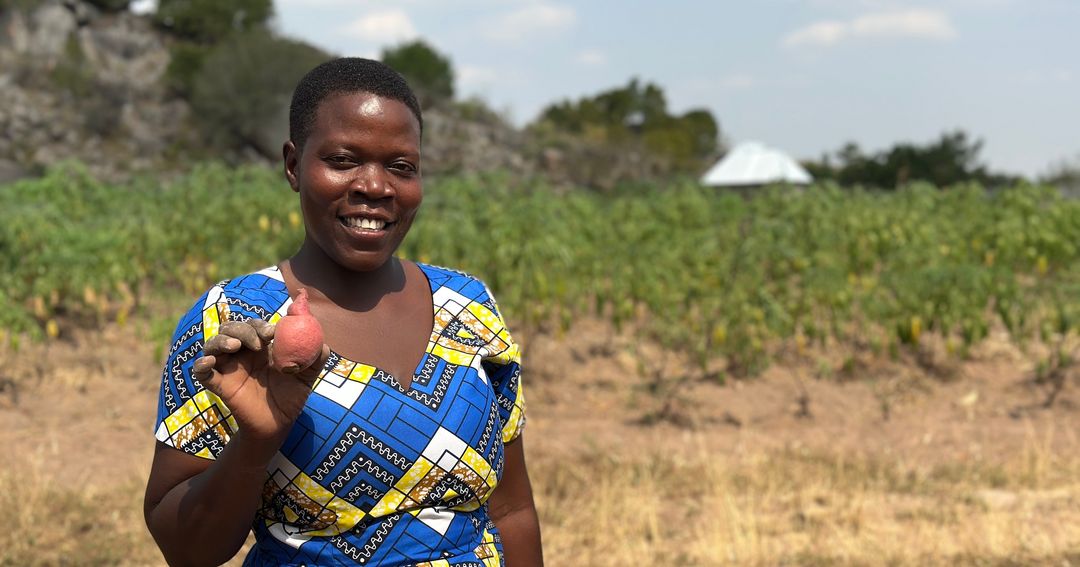
The first project concerns an unassuming tuber that holds high promise for agricultural development: the orange-fleshed sweetpotato (OFSP). Select bio-fortified varieties of orange-fleshed sweetpotato are seen as a cost-effective solution to childhood blindness caused by vitamin A deficiency and food insecurity caused by climate change.
To promote the starchy star, organizations like the International Potato Center (CIP) have worked to get orange-fleshed sweet potatoes into the communities that most need them. But distributing seeds alone doesn’t guarantee they’ll sustainably end up on plates, in bellies, and embedded into the local economy. That’s why evaluating how programs are delivered and who benefits is essential. CIP has therefore partnered with AidData for years to measure and improve the efficacy of their orange-fleshed sweetpotato interventions.
AidData’s sweetpotato research has already provided CIP with information that can help strengthen its approach. In 2024, AidData evaluated a CIP emergency orange-fleshed sweetpotato program implemented in Ethiopia. “We found a significant number of farmers retained specific agricultural information about OFSP, and almost 20% of them still cultivate the variety,” said AidData Research Scientist and project lead Katherine Nolan..
Of particular concern to CIP moving forward: making sure Ghanaian farmers have equal access the sweetpotato farming practices CIP promotes. “Across Ghana, much of the farming knowledge comes through social networks, to which women often lack access,” said Nolan.
AidData’s research on gendered social networks has shown that spouses share a median of just two connections—leaving about 80% of husbands’ and 75% of wives’ networks separate from each other's circles. This suggests a strong need to survey both spouses to capture a household’s full social network and build programs that deliver information through both sets of networks. Building on this research, AidData will examine how social networks interact with CIP programs and their impacts on households. “By investigating how information spreads through gendered social networks, and how that information impacts uptake of program activities, we aim to help our CIP partners maximize the benefits of future potato programming," said Nolan.
Ethiopia: Does a job seeker support program improve job match rates, and does it work equally for men and women?
.jpg)
The second project that AidData is evaluating attempts to address Ethiopia’s high youth unemployment rate, which stands at 26%. But that statistic obscures a worrisome fact: young urban women are disproportionately unemployed (35%) compared to their male counterparts (17%), according to the Ethiopian Statistical Service.
One reason rates remain elevated: signaling your value to a potential employer is difficult, particularly for women. “While you or I may signal our employability by updating our LinkedIn profiles, job seekers in Ethiopia rely more on referral networks, where a current or former coworker refers you to a future opportunity,” said AidData Research Scientist and project lead Rachel Sayers. This can make finding a new job difficult—particularly for young women who lack networks and prior experience.
To understand these challenges, AidData collaborated with the Policy Studies Institute (PSI), a think tank focused on economic research and policy analysis in Addis Ababa, Ethiopia, and Afriwork, an Ethiopian platform that connects employers with job seekers. Afriwork's job seeker support program helps users craft resumes and cover letters tailored to specific applications, aiming to reduce search friction and place more people in jobs. AidData conducted a randomized control trial (RCT) to evaluate the program’s effectiveness at improving job match rates and the quality of those matches. Of central concern: whether the platform works equally well for men and women.
While the results of that trial are still being analyzed, Sayers notes that the sample leverages Afriwork's user base to focus on discouraged job seekers, a group that is often hard to reach. The team then stratified the sample by gender, according to Sayers. “We contacted both men and women at similar rates, ensuring even gender balance across both treatment groups. This will allow us to draw statistically robust conclusions about Afriwork’s potential effectiveness for men and women."
With the new round of funding from the Hewlett Foundation, AidData will conclude and publish the results of the RCT. Beyond helping Afriwork better understand its program's effectiveness, the analysis will give policymakers key data on addressing youth unemployment and gender inequities in the Ethiopian job market, through dissemination by the Policy Studies Institute.
Rwanda: How is land use changing, and how can AidData build local capacity for future impact evaluations?
The Rwandan government wants to build out the country’s urban infrastructure. Under its Project 2050 plan, Rwanda aims to have 70% of the population living in urban centers—a massive jump from the current rate of 30%. But building that infrastructure comes with potential costs to ecosystems and human communities alike. To mitigate these risks, Rwanda’s National Land Authority (NLA) has developed land use plans. But the NLA needed support assessing how land actually changed over the past decade—and how it may change in the future.
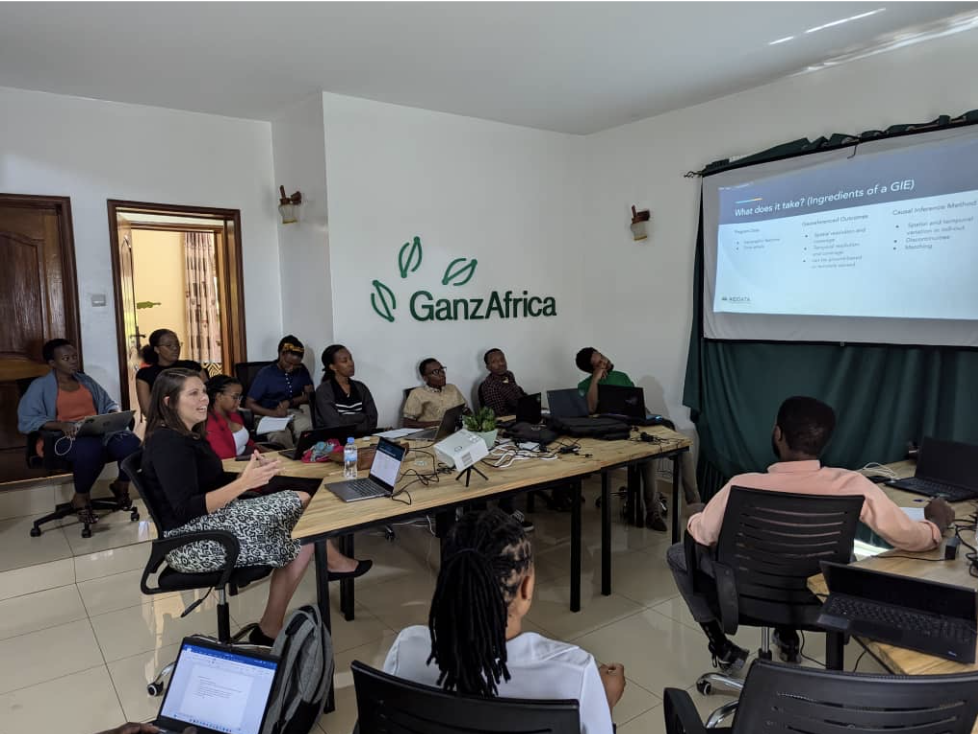
The final project will leverage AidData’s geospatial expertise and our partner GanzAfrica's on-the-ground networks to assess the extent and impact of urbanization in Rwanda. Set to begin shortly, the research will consist of two complementary workstreams that examine the extent of urbanization and who benefits from it.
Firstly, AidData researchers will work with GanzAfrica fellows to provide a historical perspective on how Rwanda land use has changed over the past ten years. “Using satellite imagery, AidData will work with GanzAfrica collaborators to analyze patterns of land use change in selected areas in Rwanda and understand how these line up with official land use policies,” noted AidData Research Scientist and project lead Jessica Wells. By partnering with AidData for the analysis, GanzAfrica Fellows will gain internal capacity to conduct future analyses. “When AidData’s work concludes, we want GanzAfrica researchers to be able to conduct similar research in additional areas to address future questions surrounding Rwanda’s urban planning," said Wells.
Secondly, AidData will assist GanzAfrica Fellows as they survey policymakers on how land use policies are designed and implemented and locals on the impact of growing urbanization. “These surveys will give us a more holistic picture of what policymakers are doing and what local residents think of urbanization, helping to guide future policy,” said Wells.

As the projects wrap up, Nolan, Sayers, Wells, and their partners are committed to ensuring the findings travel far beyond academic circles. The results will be shared through two peer-reviewed papers and two policy briefs aimed at practitioners and policymakers, with additional outreach to make the work accessible to broader audiences.
“Taken together, these projects embody a straightforward but urgent conviction: that in a world of shrinking aid budgets, every development dollar must be spent with evidence, equity, and accountability in mind,” said Sayers.
To this end, an encouraging note: in early 2026, U.S. Congressional appropriators included $25 million in the FY 2026 State-Foreign Operations funding bill to be made available for impact evaluations of the effectiveness and sustainability of U.S. government foreign assistance programs going forward.
For media inquiries, reach out to Alex Wooley, Director of Partnerships and Communications, awooley@aiddata.wm.edu; +1.757.585.9875.
.jpeg)