
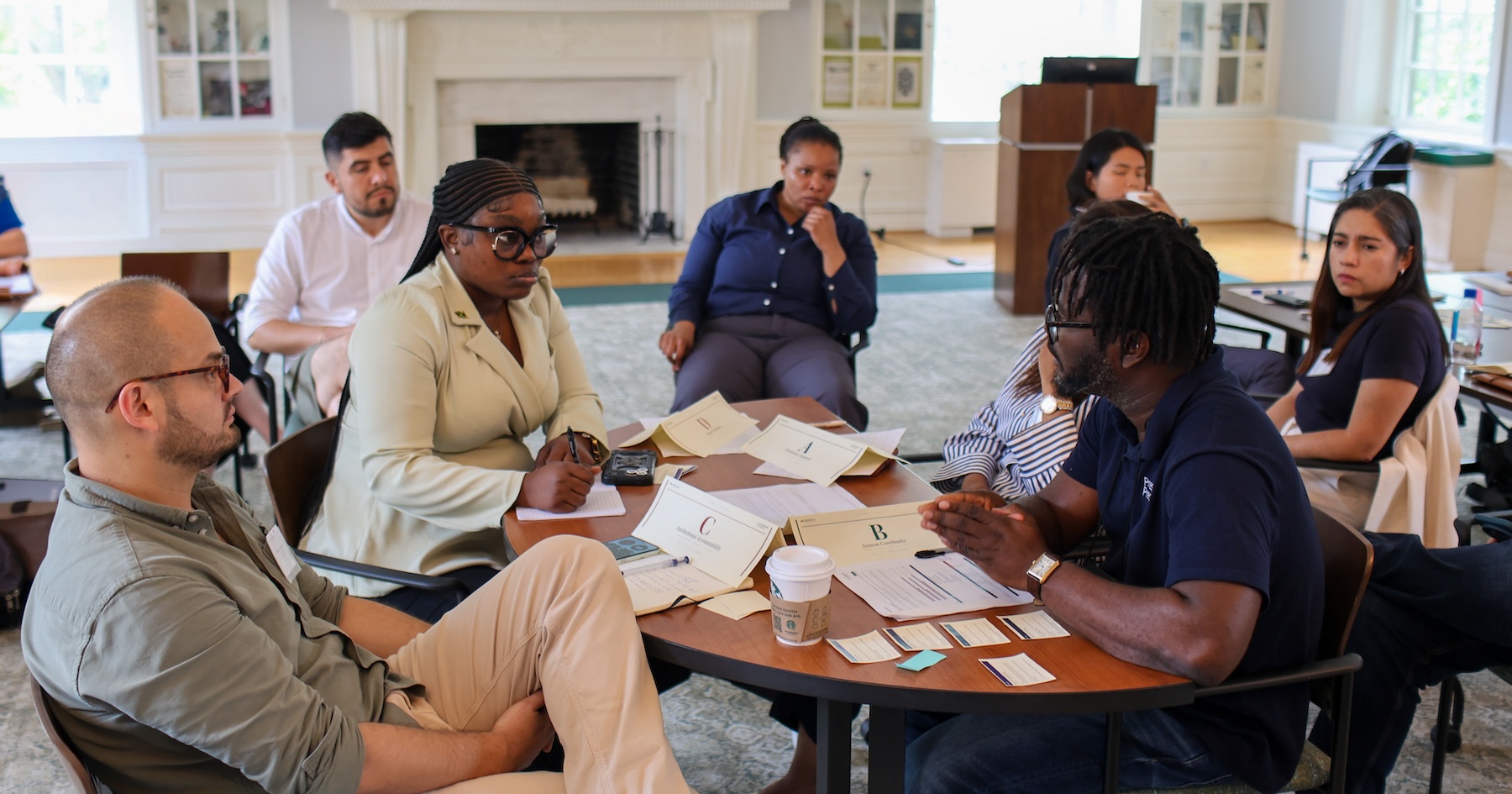
Simulation is a core feature of the AidData Training Initiative to equip current and future leaders with the toolkit to make real strategic decisions under pressure. It represents a way to move beyond presenting research findings by placing participants inside the institutional pressures, trade-offs, and evidence constraints that shape real policy decisions.
This summer, AidData ran a three-hour simulation for a cohort of the Global Democracy Fellowship. The six-week immersive leadership program, hosted by the Presidential Precinct, is designed for rising and established international leaders committed to strengthening democratic institutions and civil society. Participants in “Data Command” took on the roles of officials inside the fictional Republic of Aruvia, a newly democratic government preparing to assume responsibility for a donor-funded health system serving 3.2 million people. While the scenario was fictional, the governance problem was not.
As AidData’s Training and Instructional Design Manager, my goal was to equip participants with the techniques they can still use six months from now, when the same kind of pressure turns up with no facilitator in the room. Nearly every choice was less about handing people data than about actively rehearsing a systemic way of decision making that holds up under stress.
The research problem behind the simulation

“Data Command” was grounded in previous AidData research on transparency and public-service delivery. An AidData study on open government in the Philippines, From Pork to Performance, found that publishing data does not automatically improve services or accountability. For open data to be useful, there must be coordination between agencies, timely reporting, usable information, frontline feedback, and institutions with the ability to respond. A government may therefore possess data without possessing an agreed-upon account of reality. It may publish its own set of indicators, while ministries apply different definitions, collect information on incompatible timelines, or simply lack the capacity to verify what is happening at the point of delivery. International donors can exacerbate the issue, by financing the outputs of a system while leaving the state without the workforce, financial controls, supply-chain capacity, or accountability mechanisms required to manage that system independently.
This research finding shaped our simulation’s central problem: a government may have data but lack a shared, trustworthy account of reality. The research was built into the simulation’s mechanics: its roles, evidence, constraints, and decision points required participants to govern with data that was available, but not yet sufficient to create a common basis for action.
A handover, and two reports that disagree
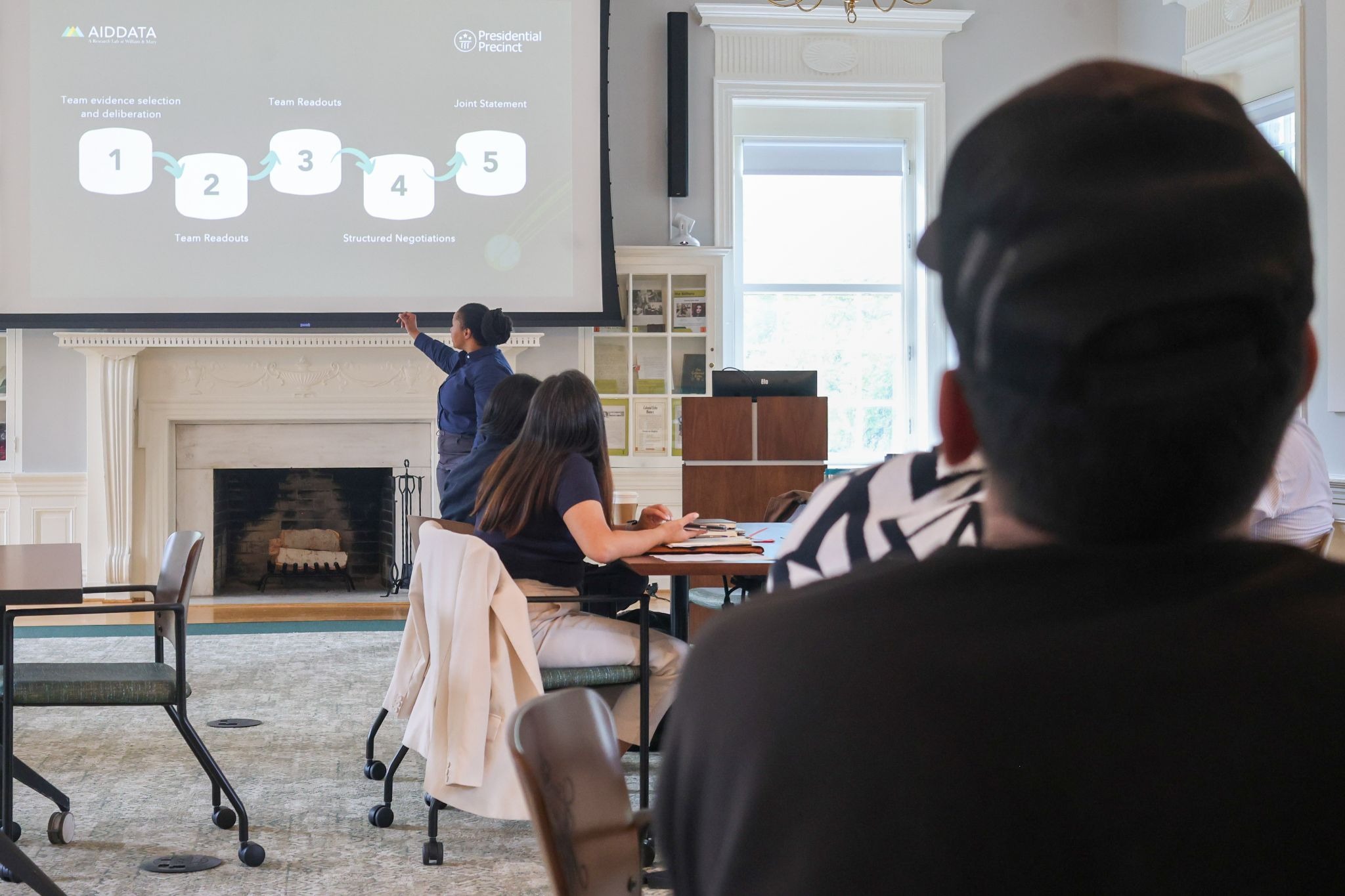
Within the simulation, the fictional Republic of Aruvia is a country of 11.4 million, four years into its first democratically elected government—one that won on a promise to wean the country off donor money. For several years, a donor has run a parallel health system on its behalf: providing primary care, maternal health, vaccinations, and HIV and tuberculosis treatment for 3.2 million people, making up about 40 percent of the country’s primary-care coverage. Now that system is being handed over for the government to run itself. A transition agreement signed by the previous administration, inherited by this one without a word of renegotiation, fixes the handover date. In 72 hours, the donor’s board will decide whether to proceed with the handover, impose additional conditions, delay the transition, or withdraw.
Participants received two reports measuring different things. One assessed progress on health system localization against the ministry’s internal targets. The other measured whether the government possesses the operational capacity required to maintain health services after the handover. Participants therefore could not simply choose the “correct” number. They had to decide what the government could responsibly claim and do, while the evidence remained contested.
Turning research into governing practice
The “Data Command” simulation was not designed to tell participants which report to trust or which policy position to adopt. Instead, it let leaders experience what governing looks like when interrelated institutions see the same problem differently and delay carries consequences of its own.
By the end of the session, the Fellows had moved from separate institutional positions to a single public statement they could defend. In doing so, they had to weigh legal commitments, service continuity, fiscal limits, public accountability, and donor relations.
But “Data Command” was not the only hands-on training exercise informed by AidData’s research. In a session led by Divya Mathew, AidData Associate Director of Policy Analysis, Fellows were exposed to the diplomatic, informational, military and economic (DIME) instruments of national influence, drawn from AidData research on Chinese state-directed finance and media strategy in the Philippines and Indonesia. The exercise used a real world case study to identify the objectives, methods, target audiences, and desired outcomes of an influence operation. Fellows left with a practical framework for identifying and evaluating foreign influence campaigns, as well as a deeper appreciation for how governments employ instruments of power to shape perceptions, decisions, and behavior.
That is the pedagogic value of simulations within the AidData Training Initiative. AidData’s extensive research provides the evidence base and simulation turns that evidence into a critical and active learning environment. It allows participants to practice a data-informed decision-making process, interpret uncertainty, negotiate across institutions and interests, and make commitments that can withstand public scrutiny.
The Data Command simulation on data-informed governance was designed and delivered by Sethu Nguna for the Presidential Precinct’s 2026 Global Democracy Fellowship.
