

For decades, the United States and Japan reliably channelled official development assistance (ODA), or aid, to countries across Southeast Asia based on the needs of recipient countries.
Over the past 25 years, the region’s economies have exploded in global importance, China has re-written global financing rules, and the old aid donor-recipient dynamic has begun to shift towards decisions based on the strategic interests of the financiers.
Southeast Asia sits at the center of global maritime supply routes, holds critical mineral deposits, and boasts a young, largely urban workforce. How the United States, Japan, and China economically engage the region moving forward is a core economic security question with global consequences.
A recent AidData panel discussion held at the W&M Washington Center in D.C. explored insights from a new policy brief co-authored by Divya Mathew, Bryan Burgess and Jonathan Solis. Drawing from AidData’s China’s Global Loans and Grants Dataset, it provides in-depth data and analysis to answer a pivotal question in economic security policy: what will the future of development finance to Southeast Asia look like?
Featuring a presentation on new research findings from Divya Mathew, Associate Director of Policy Analysis at AidData, with Alex Wooley, AidData’s Director of Partnerships and Communications, moderating, the panel incorporated leading experts in official financing and Southeast Asian development cooperation: Dr. Alvin Camba of the Atlantic Council and Lyvi AI, Dr. Kuniko Ashizawa of George Washington University, and Noto Suoneto of Foreign Policy Talks.
“While it’s hard to predict the future, historical data provides an invaluable perspective on where we might be heading,” noted Mathew, lead author of the brief.
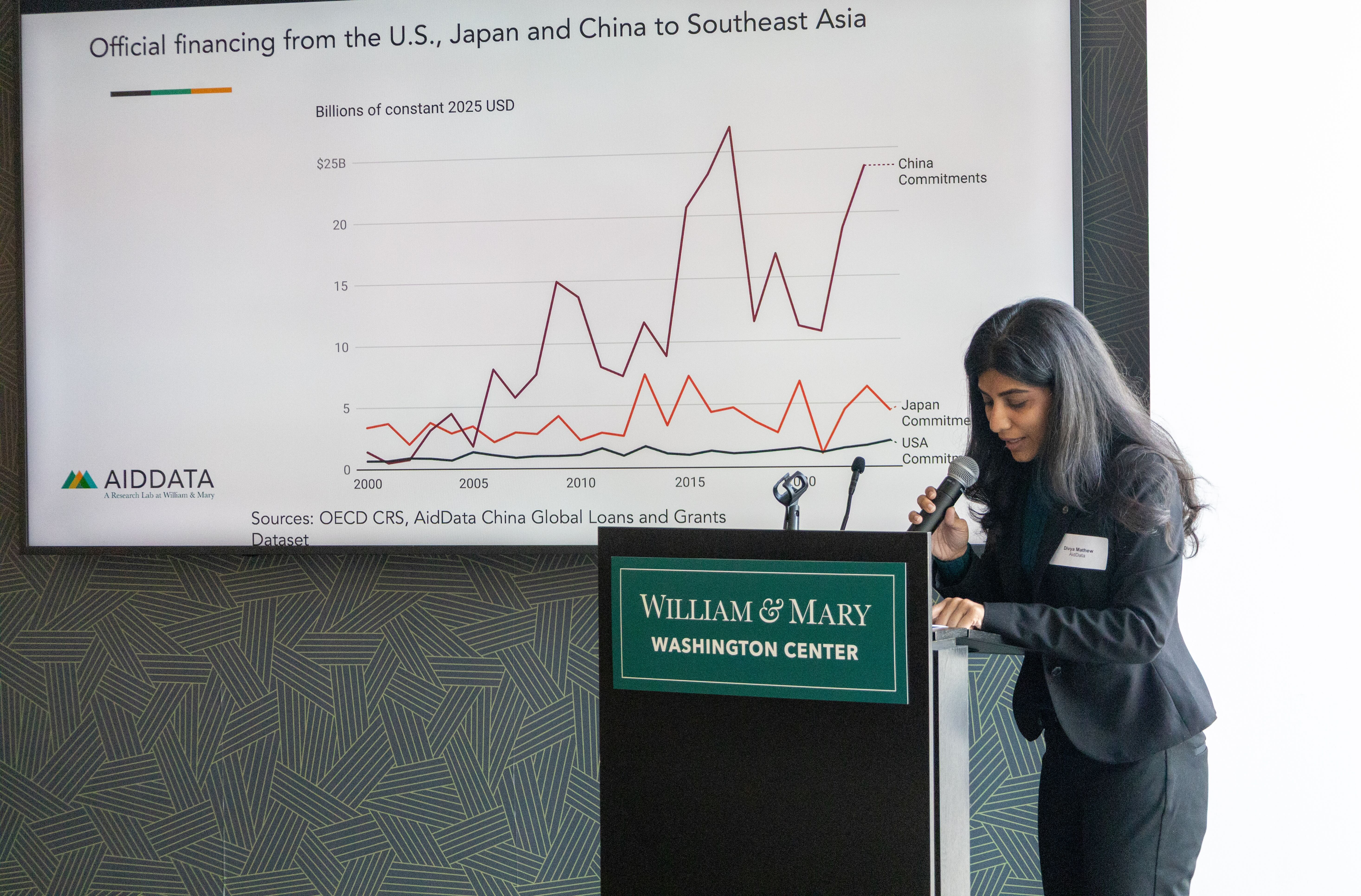
25 years of investments
From 2000 to 2024, the United States, Japan, and China collectively provided $387.3 billion in official finance to 11 Southeast Asian economies, but the three financiers diverged sharply in scale, stability, and instrument choice. China dominates by volume, accounting for 68% of total flows at $261.7 billion, with financing issued predominantly as loans and fluctuating dramatically from year to year. The U.S. picture is nearly inverted: just 7% of total flows, but with 93% of its financing delivered as grants. Japan sits between these extremes, contributing $95.8 billion—25% of overall flows—with greater consistency than China. When measured as a share of the financier’s GDP, Tokyo periodically rivals or even exceeds Beijing in revealed strategic commitment to the region.
But despite China’s recent fiscal dominance over the region, “the Japanese government has been careful not to frame their engagement in the region as an attempt to contain China, unlike the U.S. who has been quite vocal” said Dr. Ashizawa. Instead, Japan’s official posture has focused on a “rules-based international order across the Indo-Pacific.”

Perceptions of the U.S., Japan, and China in Southeast Asia
However, previous research shows that China’s lead in development finance dollars hasn’t translated directly to influence across the region. AidData’s Listening to Leaders survey of Southeast Asian elites shows that China doesn't appear as a top ten influential or helpful development partner in the region.
According to panelist Alvin Camba, this discrepancy could be a result of two forces.
The first: access to cultural products. “The Japanese have had a long, long history of influence in the region. Growing up 20 years ago in Southeast Asia, we watched Japanese and American shows. But China’s attempts to shape the cultural landscape have only really emerged in the past five years,” said Dr. Camba. In addition, government restrictions on media in countries like Malaysia, the Philippines, and Indonesia dictate what citizens can and cannot find.
The second: China negotiates with heads of state on highly flexible terms. This means host country leaders have leeway to favor other in-country elites and improve their personal political standing. By contrast, Japanese and American projects have more conditionality. This buffer helps curb concentrated political corruption and “allows American and Japanese development finance to be more evenly distributed to the population and benefit more people overall,” said Dr. Camba.

The road ahead
With the reauthorization of the U.S. International Development Finance Corporation (DFC) and a renewed emphasis on the Indo-Pacific region from the current U.S. administration, the panelists see an opening for deeper U.S.-Japan coordination. “There should be a stronger alliance between the U.S. and Japan when it comes to Southeast Asia,” said Noto Suoneto.
But China, Japan, and the U.S. face headwinds of their own. Panelists note that development finance remains uneven and contested in fragile states like Myanmar, Japan faces mounting pressure to sustain its commitments amid a weakening yen and rising defense budget, and successful American economic statecraft in the region requires consistent diplomatic engagement in addition to dollars.
Meanwhile, Southeast Asian countries aren’t just waiting around. “A more connected ASEAN is a more secure ASEAN,” said Suoneto. Citing a recent report composed by Southeast Asian countries, Suoneto noted that there's a growing movement for ASEAN countries to define and develop their own economic security plan, rather than leave it to outside powers to write it for them.
.jpeg)